

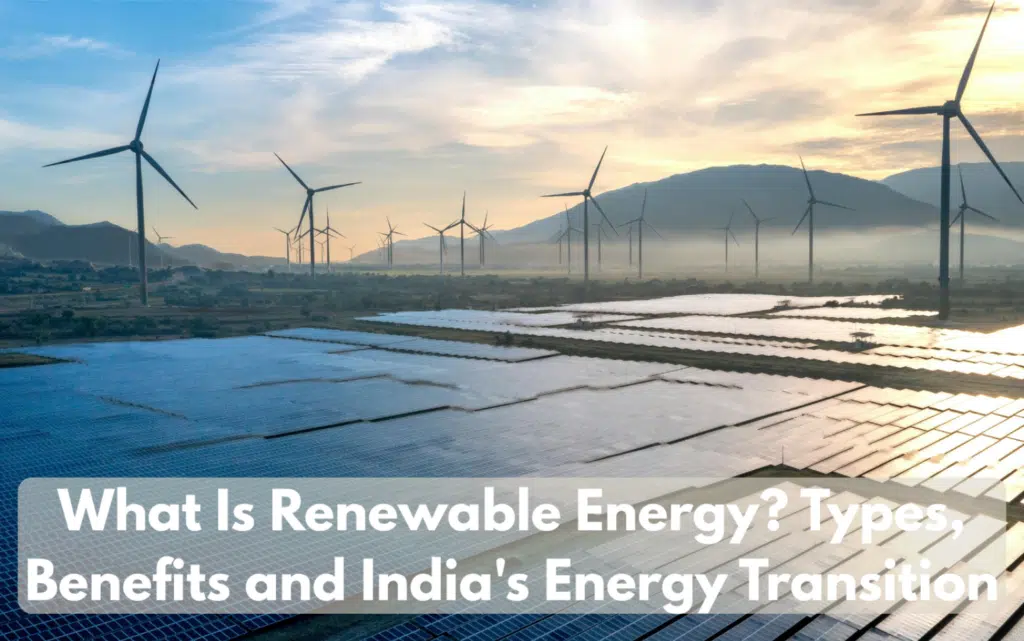
Every time a solar panel catches the sun or a turbine turns in the wind, something quietly replenishable is being converted into electricity. That’s the basic idea behind renewable energy, and it’s become one of the most repeated phrases in global policy over the past decade. What gets repeated less often is how far a country’s installed capacity actually has to travel before that electricity is genuinely homegrown, start to finish.
What Renewable Energy Actually Means
Renewable energy is energy derived from natural sources that replenish themselves faster than they’re consumed. Sunlight and wind are the clearest examples: both are constantly renewed regardless of how much energy is drawn from them. Fossil fuels work the opposite way. Coal, oil and gas take hundreds of millions of years to form, and burning them for energy releases greenhouse gases that renewable sources largely avoid at the point of generation.
That distinction, replenishable versus finite, is the actual definition. “Clean energy” and “green energy” are used informally for the same thing, but they’re shorthand rather than technical terms, and they can blur the line between a source that’s genuinely renewable and one that’s simply lower emission than coal.
The Main Types of Renewable Energy
Solar energy is the most abundant resource available, and it can be harnessed through photovoltaic panels or through mirrors that concentrate solar radiation for heat. The cost of manufacturing solar panels has fallen sharply over the past decade, making it one of the cheapest sources of new electricity generation in many markets.
Wind energy captures the kinetic energy of moving air using turbines sited onshore or offshore. Technology has shifted toward taller turbines and larger rotor diameters to extract more electricity per installation, and offshore wind in particular still has considerable untapped potential.
Hydropower harnesses the energy of water moving from higher to lower elevation, either from large reservoirs or from the natural flow of a river. It remains the largest single source of renewable electricity generation worldwide, though large reservoir projects can also affect local ecosystems and river flow patterns in ways smaller, run-of-river projects generally avoid.
Geothermal energy draws on heat stored within the Earth’s crust, extracted through wells, and has been used for electricity generation reliably for more than a century in locations with naturally hot, permeable reservoirs.
Bioenergy comes from organic material such as wood, crop residues and agricultural waste, burned or processed for heat, power or liquid fuel. It produces lower emissions than coal or oil when burned, but not none, and large-scale bioenergy expansion raises its own land use questions, a theme that shows up elsewhere in the energy transition as well.
Ocean energy, which captures the kinetic and thermal energy of waves, tides and currents, remains mostly at the prototype stage globally, though its theoretical potential is large.
Where India Stands
India’s renewable energy numbers have moved quickly. Installed renewable capacity reached roughly 254 GW by December 2025, and total non-fossil capacity, which adds nuclear power to the renewables figure, stood at around 283 GW by March 2026. India crossed the milestone of 50% non-fossil electricity capacity in June 2025, five years ahead of its own Paris Agreement commitment under its Nationally Determined Contribution. Solar capacity alone grew from just 2.82 GW in 2014 to roughly 150 GW by March 2026, a more than fifty-fold increase in a little over a decade, while wind capacity reached about 56 GW over the same period.
The national target is 500 GW of non-fossil capacity by 2030. Given where the numbers stood in early 2026, that means capacity still needs to roughly double from current levels within about four years, a pace that’s faster than anything achieved so far.
The Import Dependence Underneath the Growth
Capacity figures tell only part of the story, because manufacturing the hardware that generates renewable power is a separate supply chain from generating the power itself, and India’s position in that supply chain is considerably weaker than its generation numbers suggest.
China still supplies the majority of India’s solar cell and module imports. Depending on the year and dataset, China’s share has ranged from roughly 56% to 59% of combined cell and module imports in recent fiscal years, down from over 90% a few years earlier but still dominant. The dependence runs deeper upstream: India’s own cell manufacturing capacity has expanded to around 25 to 27 GW, but polysilicon and wafer production, the raw materials that go into those cells, remain almost entirely absent domestically, meaning even panels assembled in India often rely on imported inputs at an earlier stage. Policy measures such as the Approved List of Models and Manufacturers are aimed at closing this gap over time, but as of the most recent assessments, India’s module assembly capacity has scaled faster than its upstream cell and wafer capacity, which is exactly where the import dependence is concentrated.
This is worth sitting with for a moment, because it changes what “installed renewable capacity” actually means. A gigawatt of solar capacity commissioned in India this year is, in supply chain terms, still substantially a Chinese-manufactured gigawatt, assembled or installed domestically but not independently produced from raw material to finished panel. Capacity growth and supply chain self-sufficiency are two different achievements, and India’s progress on the first has outpaced its progress on the second.
The Practical Limits Worth Knowing
Renewable generation isn’t a straightforward substitute for fossil fuel capacity, because solar and wind output varies with weather and time of day in a way thermal power doesn’t. This intermittency means grid operators need either storage capacity, which remains expensive at scale, or backup generation to smooth out supply, and periods of oversupply can lead to curtailment, where renewable generation is deliberately reduced because the grid can’t absorb it. Utility-scale solar and wind installations also require meaningful amounts of land, which can create competing demands with agriculture or conservation in densely populated regions.
None of this makes renewable energy a weaker choice than fossil fuels. It does mean the transition involves real engineering and supply chain trade-offs that don’t disappear once a capacity target is announced.
Where This Leaves the Transition
Renewable energy’s definition is simple: power from sources that replenish themselves rather than running out. India’s progress toward generating more of its electricity this way has been genuinely fast, among the fastest of any large economy in recent years. But the hardware behind that progress still runs through a supply chain concentrated well outside India’s borders, particularly in solar. Closing that gap, not just adding capacity, is likely to be the harder half of the transition from here.



 no updates