

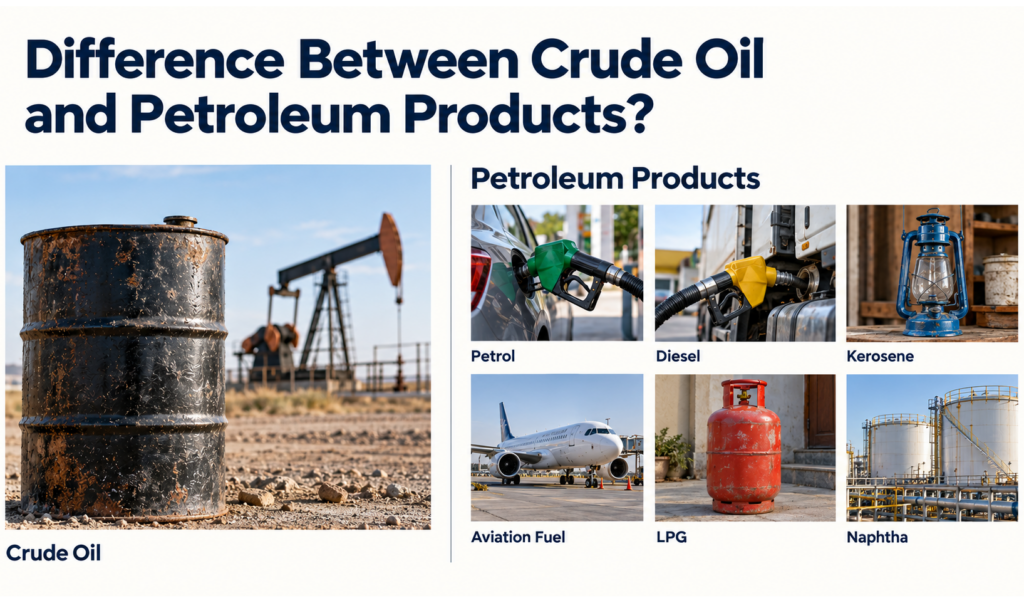
Ask ten people whether they filled their vehicle with crude oil or petroleum, and most will say “petroleum,” a few will say “oil,” and almost nobody will think about the journey the fuel took to reach the pump. The terms are often used interchangeably in everyday conversation, but they describe different things. Understanding the difference between crude oil and petroleum is the first step to understanding how fuels, polymers and thousands of everyday materials come into being.
Key takeaways
- Crude oil is the raw, unprocessed material extracted from the earth.
- Petroleum products are the fuels and materials created from it at refineries.
- “Petroleum” is the broader term that covers both.
- Refineries are the bridge that turns one into the other, and modern industry relies on that bridge every day.
What Is Crude Oil?
Crude oil is the raw, unprocessed liquid found in underground reservoirs, typically within the tiny pore spaces of sedimentary rock. It is a natural mixture of hydrocarbons, formed over millions of years as heat and pressure acted on the remains of ancient marine plants and animals.
In its natural state, crude oil is not something you can put in a car, a cooking stove or a jet engine. It is a blend of many hydrocarbon molecules, from very light to very heavy, and its colour, thickness and composition vary depending on where it was extracted. Its real value lies in what it can become once it is refined.
What Is Petroleum?
The word petroleum comes from the idea of “rock oil,” or oil from the earth. It is a broader term that covers both crude oil and the petroleum products made from it. In practice, “oil” and “petroleum” are often used interchangeably, which is why the two are so frequently confused.
A simple way to remember it:
- Crude oil is the raw material.
- Petroleum products are what the raw material becomes after refining.
- Petroleum is the umbrella term that includes both.
So when someone asks whether the correct term is “petroleum or crude oil,” the answer is that both are valid, but they are not identical. Crude oil is one form of petroleum.
What Are Petroleum Products?
Petroleum products are the useful materials produced when crude oil and other liquids are processed at refineries. They include:
- Transportation fuels: petrol (gasoline), diesel and aviation turbine fuel
- Household and commercial fuels: LPG (cooking gas), kerosene and heating oils
- Petrochemical feedstocks: naphtha and other liquids that become polymers and chemicals
- Lubricants and waxes: used in machinery, vehicles and manufacturing
- Bitumen and petroleum coke: used in road construction and heavy industry
Refineries also deliver a notable gain in volume. Because of refinery processing gain, a 42-gallon barrel of crude oil can yield about 45 gallons of petroleum products.
How Crude Oil Becomes Petroleum Products
The transformation happens at a refinery, in two broad stages.
1. Separation: Crude oil is heated in furnaces and passed into a distillation column, where its components separate according to their boiling points. Lighter fractions rise and heavier ones settle lower, producing streams such as naphtha, kerosene and diesel.
2. Conversion and treatment: Not every fraction comes out of the column ready to use. Heavier, lower-value fractions are processed further, using technologies such as cracking, to become lighter, higher-value products like petrol. Treatment steps then refine each stream to meet quality specifications, including cleaner fuel standards.
In short, refining breaks crude oil into its components and selectively reconfigures them into new products.
| Crude Oil vs Petroleum Products at a Glance | ||
| Crude Oil | Petroleum Products | |
| Form | Raw, unprocessed mixture of hydrocarbons | Refined, purpose-specific materials |
| Source | Underground reservoirs | Refineries and processing plants |
| Direct use | Very limited; must be refined first | Ready for fuel, industrial and consumer use |
| Examples | Light, heavy, sweet or sour crude grades | Petrol, diesel, LPG, naphtha, bitumen, lubricants |
Why This Difference Matters to Everyday Life
The distinction between crude oil and its products is not only technical. It reflects how deeply refining supports modern life.
- Mobility and logistics: Petrol, diesel and aviation fuel keep people, goods and services moving across roads, rails, seas and skies.
- Polymers and plastics: Refineries supply the petrochemical feedstocks that the chemical industry converts into plastics. Polymers such as polyethylene and polypropylene are embedded in packaging that protects food and medicines, pipes that carry water, components in vehicles and appliances, and medical devices. Very few modern industries operate without them.
- Infrastructure: Bitumen paves the roads and highways that connect cities, while lubricants keep industrial machinery running smoothly.
- Homes and kitchens: LPG and other fuels power household cooking across the country.
Put simply, crude oil is the starting point, and the refinery is the bridge that turns it into materials that industry, agriculture, healthcare and households rely on every day.
The Role of Refineries in India
India’s economy runs on the outputs of its refineries. The country’s refining capacity grew from about 215 million metric tonnes per annum (MMTPA) in April 2014 to about 257 MMTPA in April 2024, placing India among the world’s largest refining nations. Further expansion is planned, with the government’s roadmap projecting capacity of around 309.5 MMTPA by 2030
This scale matters because the products of refining feed nearly every sector: transport, power, agriculture, construction, manufacturing and consumer goods. As India’s industries grow, so does the importance of a strong, modern and efficient refining base, one that continues to invest in cleaner fuels and cleaner processes.
How an Integrated Refinery-Petrochemical Complex Works
Some refineries go a step further than fuels. In an integrated refinery-petrochemical complex, streams from the refinery are used directly as feedstock for a cracker, which produces the building blocks for polymers such as polyethylene and polypropylene. Keeping both operations on one site allows resources to be used more fully and widens the range of products that a single crude barrel can deliver.
A well-known Indian example is HMEL’s Guru Gobind Singh Refinery in Bathinda, Punjab. The complex combines an 11.3 MMTPA crude oil refinery with a 1.2 MMTPA multi-feed cracker, a 1.2 MMTPA polyethylene plant and a 1.0 MMTPA polypropylene plant, and it is recognised as one of India’s larger producers of these polymers. On the fuels side, HMEL produces Bharat Stage VI (BS-VI) compliant petrol and diesel, along with aviation turbine fuel, LPG, naphtha and other petroleum products. BS-VI fuel specifications are equivalent to Euro 6 quality.
The site has also continued to grow. Its refining capacity has expanded by roughly 25% to 11.3 MMTPA over the years, and the company has recently announced a further investment of around Rs 2,600 crore at Bathinda for polypropylene downstream units and new fine and speciality chemical projects. It is a useful illustration of the wider industry direction: moving from fuels alone toward higher-value polymers and chemicals that serve a growing range of Indian industries.
In summary, crude oil is the raw material drawn from the earth. Petroleum products are the fuels, feedstocks and materials created from it. “Petroleum” is the wider term that covers both. Between the two stands the refinery, the facility that turns a complex natural mixture into the fuels, polymers and materials that modern industry and everyday life depend on. As India’s refineries and integrated petrochemical complexes expand and modernise, that bridge only becomes more important.



 no updates