

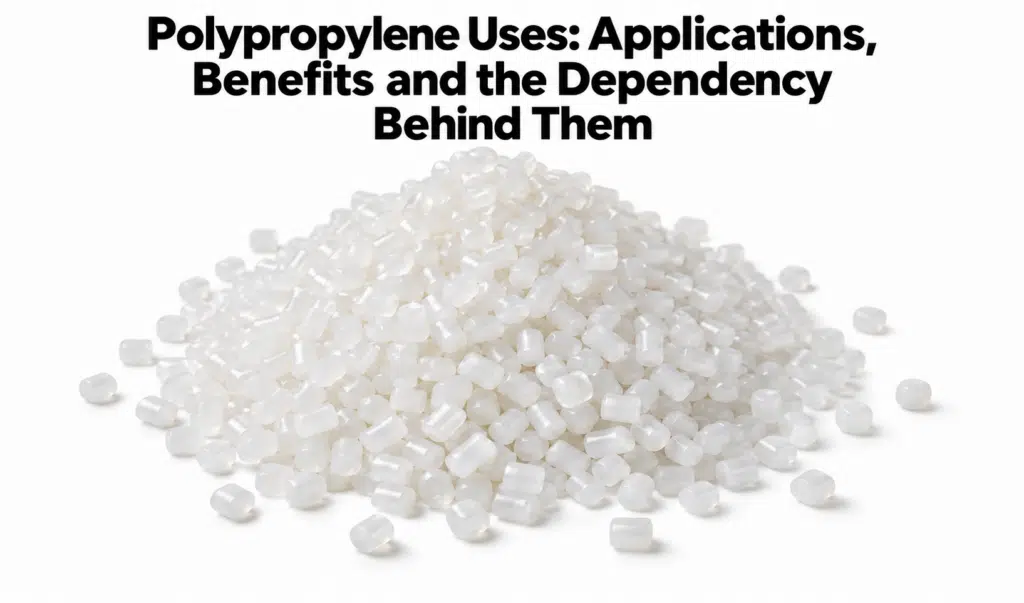
Look around the room you’re sitting in right now; chances are polypropylene is somewhere nearby. It could be the yoghurt tub in your fridge, the hinge on your shampoo bottle cap, or the patio furniture you enjoy your coffee on.
Polypropylene has quietly become one of the most widely used polymer grade on the planet. But the more interesting story isn’t just where it shows up; it’s how a material this common still leaves a country like India short of it, and how little of it ever gets a second life once it’s used.
What Makes Polypropylene So Popular?
Polypropylene, often shortened to PP, is a semi-crystalline thermoplastic first polymerised in 1951. According to Fortune Business Insights, the global polypropylene market was valued at USD 92.90 billion in 2025 and is projected to reach USD 149.07 billion by 2034, growing at a CAGR of 5.40%. Other industry estimates put current volumes at roughly 97.3 million tonnes in 2025, rising to nearly 129 million tonnes by 2030.
That scale exists because PP checks several boxes at once: it’s lightweight, chemically resistant, relatively cheap to produce, and adaptable to almost every manufacturing process in use today. Geographically, Asia Pacific accounts for an estimated 56.7% of the global market, driven by urbanisation and expanding manufacturing hubs across China and India.
Common Polypropylene Uses Across Industries
- Packaging is the largest end-use segment, historically accounting for roughly 45–58% of global PP demand, driven by its resistance to moisture, chemicals and grease. It shows up in food containers, bottle caps, cling films, and the hinges on flip-top lids.
- Automotive is the second-largest consumer, holding an estimated 11–16% of global demand depending on the year. PP appears in bumpers, battery casings, dashboards and door trims, and is typically 15–20% lighter than several alternative plastics relevant as manufacturers work toward tighter emissions standards.
- Medical and healthcare applications lean on PP’s resistance to steam sterilisation and chemical corrosion; syringes, vials, pill containers and Petri dishes are commonly made from it.
- Textiles and fibres: ropes, twine, carpets, upholstery and camping gear take advantage of PP’s waterproof nature, which also makes it common in marine fittings.
- Electrical and electronics manufacturers use it for cable insulation and appliance casings, thanks to its insulating properties.
- Construction applications include piping systems and fittings, largely due to PP’s strength-to-weight ratio and resistance to corrosion.
Homopolymers vs Copolymers
PP broadly comes in two types. Homopolymers, made purely from propylene monomers, are common in textiles, packaging, pipes and medical components. Copolymers, made by polymerising propylene with ethylene, are softer with better impact strength, and are used where flexibility and toughness both matter. Manufacturers choose between the two depending on whether they’re moulding rigid containers or extruding flexible film.
The Gap Between Production and Self-Sufficiency
Here’s where the popularity narrative gets more complicated. India is one of the largest consumers of PP in the world; polypropylene alone accounted for more than 37% of the country’s overall polymer demand in FY2022-23, with demand rising from roughly 5.26 million tonnes in FY2019-20 to a forecast 6.97 million tonnes in FY2023-24.
India also has a genuine domestic production base: several integrated refiners, including Reliance Industries, Indian Oil Corporation, HPCL-Mittal Energy (HMEL) and ONGC Petro Additions, have built PP capacity alongside their refining operations specifically to reduce reliance on imports.
Despite that, India remains the world’s third-largest importer of polypropylene, behind China and Turkey, bringing in around 1.6 million tonnes in 2024. Import volumes rose further in 2025: India imported roughly 1.2 million tonnes of PP in the first eight months of the year alone, up 16% year-on-year and running at record levels, with the Middle East and Asia-Pacific each supplying roughly 48% of that total.
Domestic industry bodies, including the Indian Chamber of Commerce, have separately petitioned the government to raise import duties on polymers, arguing that low duties continue to discourage domestic producers and deepen import dependency even as local capacity expands. In short: producing more polypropylene domestically hasn’t yet translated into needing less of it from abroad, a pattern that shows up across several of India’s other polymer categories as well.
The Recycling Problem Nobody Advertises
Polypropylene (PP) is one of the most widely manufactured plastics globally, but its recycling journey presents several challenges. Its recycling rate is often cited at around 3%, compared with roughly 10% for HDPE and 15% for PET. These differences are linked to the technical complexities of recycling PP, including heat sensitivity during mechanical recycling and changes in melt-flow rate and molecular weight with repeated reprocessing.
Another consideration is the suitability of recycled PP for food-grade applications, where stringent regulatory standards can limit the use of recycled material in packaging. As a result, the industry continues to explore solutions that can improve the quality, consistency and usability of recycled PP across applications.
Encouragingly, brands and packaging manufacturers are increasingly experimenting with mono-material PP packaging, which can simplify sorting and improve the potential for recycling. At the same time, ongoing innovation in recycling technologies and material recovery is creating opportunities to increase the availability and quality of recycled PP, including for more demanding applications.
A Few Other Trade-Offs
PP is flammable at higher temperatures and prone to UV degradation with prolonged sun exposure. None of this cancels out its functional usefulness, but it explains why plastic waste and circularity keep showing up as open problems in industry reports rather than solved ones.
Where the Raw Material Comes From
Polypropylene is derived from propylene, a by-product of petroleum refining and naphtha cracking, which is why the polypropylene supply chain is inseparable from the refining industry. In India, this link runs through a handful of integrated refiners that convert refinery streams into polymer-grade resin rather than depending purely on imported feedstock; HMEL’s Guru Gobind Singh Refinery in Bathinda, Punjab, which houses a dedicated petrochemical unit built around a dual-feed cracker, is one such facility, alongside comparable units run by Reliance, IOCL and ONGC Petro Additions.
In conclusion, polypropylene’s numbers are real: a market approaching USD 93 billion, present in nearly every industry that touches daily life. But the same data that explains its popularity also points to two problems the industry hasn’t solved: a large consuming economy like India remains structurally reliant on imports even as domestic capacity grows, and the material’s own recyclability lags well behind the scale at which it’s produced and discarded. Both are likely to shape how the polypropylene industry evolves over the next decade more than growth projections alone.



 no updates