

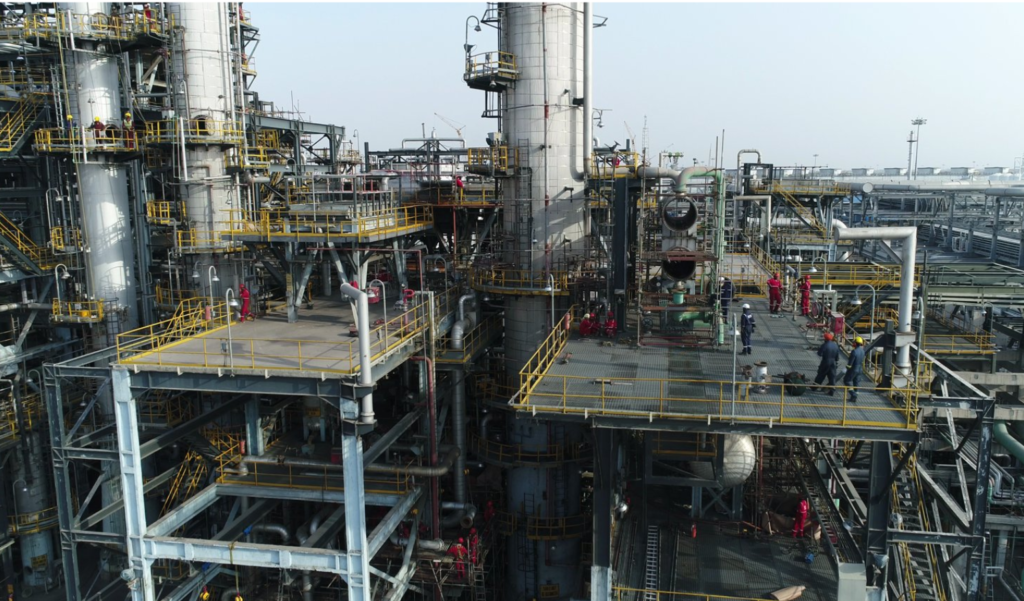
From the road, an oil and gas refinery looks like a maze of towers, pipes and flare stacks. Inside, it’s a tightly run system where every unit feeds the next. This guide looks at how that system fits together and how India’s refineries compare, without getting lost in the chemistry.
Where a Refinery Sits in Oil and Gas Industry Processes
The oil and gas industry processes are usually split into three parts. Upstream is exploration and production. Midstream is transport and storage by pipeline, ship or truck. Downstream is refining and selling. Chandra Asri’s overview places the refinery in that downstream part. The oil refining industry is what turns raw, variable crude into products with fixed specifications.
The Oil Refinery Process in Brief
The oil refinery process has a clear order. Crude is heated and separated by distillation into fractions. Heavy fractions are broken into lighter ones in conversion units. Impurities such as sulphur are removed, and the finished streams are blended to specification. A petroleum refinery runs these steps continuously, around the clock. We cover each stage in more detail in our guide to the crude oil refining process.
Oil Refinery vs Gas Processing Facility
A gas processing facility works on a different raw material. Natural gas comes out of the ground as a mixture of methane, heavier gases, water and sometimes acid gases such as hydrogen sulphide. The gas refinery process removes the water and acid gases, then separates the heavier gases, often called natural gas liquids, from the methane. That’s why people also call it an oil and gas processing plant when it handles both streams on one site.
Both are examples of a petroleum processing facility. The difference is the starting material and the products. A refinery mostly makes liquid fuels and petrochemical feedstocks, while a gas plant makes pipeline-quality gas and liquids such as propane and butane, the main components of LPG.
Refinery Operations Inside the Fence
Refinery operations involve far more than the main process units. Alongside the distillation and cracking units sit hydrogen plants, sulphur recovery units, boilers, power generation and water treatment. Flare systems safely burn off gas during upsets, and effluent treatment handles wastewater before discharge. Control rooms watch thousands of readings, and the plant is shut down for planned maintenance at set intervals.
Safety is built into every layer. Because the products are flammable and the equipment runs hot and under pressure, plants rely on alarms, shutdown systems and strict procedures.
India’s Refineries by Capacity
India has 23 refineries and about 258 million tonnes a year of capacity, according to the Petroleum Planning and Analysis Cell. Eighteen are in the public sector, three are private, and two are joint ventures.
A few of the larger sites show how different they are in scale:
| Refinery | Capacity (million tonnes a year) |
| Jamnagar (Reliance, two refineries on one site) | about 68 |
| Vadinar (Nayara Energy) | 20 |
| Kochi (BPCL) | 15.5 |
| Panipat (Indian Oil) | 15 |
| Bathinda (HMEL) | 11.3 |
Searches for the best oil refinery in India usually assume one answer, but it depends on the yardstick. Capacity favours Jamnagar. Complexity, which measures how much heavy crude a plant can convert, tells a different story. Product mix and location matter too, since a plant close to its customers spends less on moving fuel. Sizing matters, but so does uptime.
A large plant that’s shut down earns nothing, which is why maintenance stoppages are planned months ahead and why the schedule can move a refinery’s output for weeks. The table above leaves the judgement to the reader.
Operations Shaped by Supply and Policy
No refinery runs in isolation. PPAC data shows India’s crude oil import dependency reached 88.2% in FY2025 and touched 90.6% in May 2025, so shipping routes and global prices can influence refinery operations as much as the plant’s own design. Prices matter too. A refinery’s margin is the gap between what it pays for crude and what it earns from its products, so a move on either side shows up quickly in how hard the plant is run. Fuel quality rules, such as BS-VI limits on sulphur, also set targets that every site has to hit.
Government policy affects the product mix as well. LPG, for instance, is in high demand for household use, and India imports more than 60% of what it consumes, which gives refiners and policymakers reason to look at how much LPG each plant can produce.
What to Take Away
An oil and gas refinery isn’t a single machine. It’s a chain of units, utilities and safety systems that has to keep running, with crude arriving from distant ports and products leaving for a whole country. India’s refining capacity keeps growing, but how much of that chain it controls still depends on where the crude comes from.




 no updates