

Roads, runways, roofing, waterproofing. Bitumen sits underneath an unusually large share of built infrastructure without most people ever noticing it. It’s also a material India depends on more heavily than its own refining capacity can currently supply, a detail that becomes relevant every time a highway project gets delayed for reasons that have nothing to do with construction crews.
What Bitumen Actually Is
Bitumen is the thick, black, sticky residue left over after the lighter, more valuable fractions of crude oil have been removed through distillation. It’s not the same thing as asphalt, despite the two terms often being used loosely as if interchangeable. Bitumen is the binder: a sticky material that holds other things together. Asphalt is the finished mixture, bitumen blended with stone, sand and other aggregates to form the road surfacing material vehicles actually drive on. Bitumen on its own goes into roads, roofing membranes and waterproofing layers; asphalt is specifically the construction material built from it.
How It’s Produced
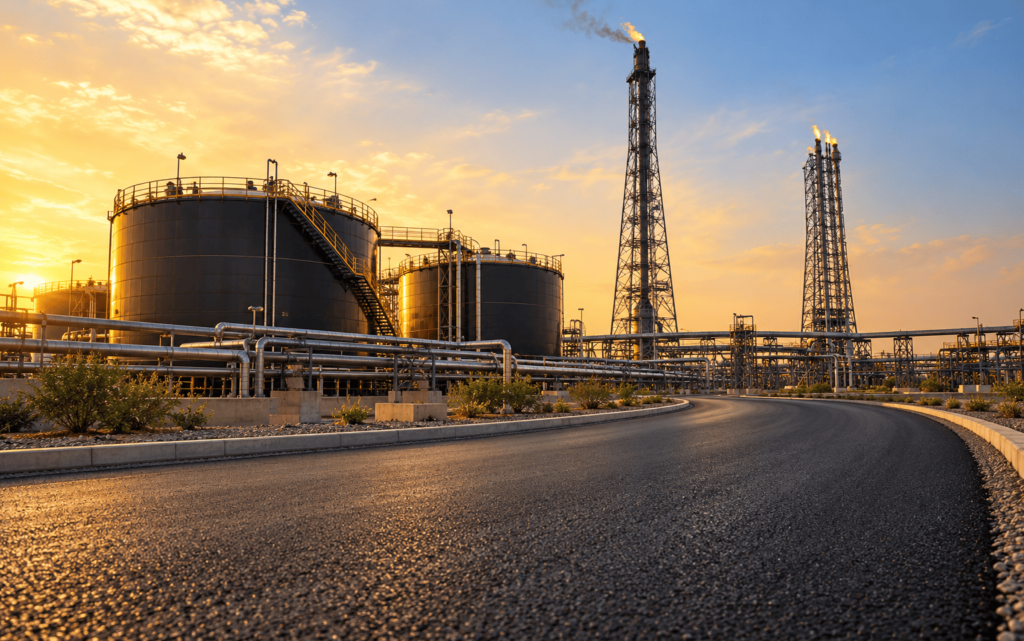
Bitumen production starts with standard crude oil distillation, where lighter products such as petrol, diesel and kerosene are drawn off first. What remains is further processed through vacuum distillation, which removes additional light components under reduced pressure and refines the material into bitumen of the required consistency. The output is then tested for viscosity, penetration value and softening point before it’s cleared for use, since different applications call for different grades. Finished bitumen is stored in heated tanks, typically between 150°C and 170°C, to keep it liquid and workable for transport.
Grades and Types
India classifies paving-grade bitumen using viscosity grades, commonly VG10, VG30 and VG40, with the number broadly indicating stiffness and the grade selected based on climate, traffic load and road type. Beyond standard paving grades, several modified and processed variants serve specific needs. Polymer-modified bitumen, made by blending polymers into standard bitumen, offers greater strength and flexibility and is typically used on high-traffic roads and highways that see heavier wear. Bitumen emulsion, bitumen dispersed in water, is used mainly for road repairs and maintenance work where the material needs to be applied without heating. Cutback bitumen is blended with solvents to make it easier to apply in specific construction conditions. Oxidised bitumen, produced by blowing air through the material, is used mainly in roofing and waterproofing rather than road construction.
Where It’s Used
Roads account for the large majority of bitumen demand. Roughly 85% of India’s paved road network is flexible pavement, meaning it’s built using asphalt, which in turn depends on bitumen as its binder. Beyond roads, bitumen is used in airport runway construction, roofing membranes, waterproofing for building foundations and walls, protective layers on bridges, and various industrial coatings.
India’s Bitumen Gap
Here’s where bitumen’s story stops being purely a materials question and becomes a supply chain one. India imports roughly half of its annual bitumen requirement, around 3.21 million tonnes in FY2023-24, even as road-building programmes such as Bharatmala and the Pradhan Mantri Gram Sadak Yojana push domestic consumption to record levels, 8.87 million tonnes in 2023 alone, up more than 10% from the year before.
That import dependence isn’t a minor footnote. Recent disruptions to West Asia supply routes doubled bitumen prices at points and directly threatened government highway construction targets, since a large share of India’s bitumen imports originate from Gulf suppliers. Part of the reason domestic refining hasn’t closed this gap is that refiners routinely cut bitumen production during monsoon season to prioritise petrol and diesel output instead, since road paving slows during heavy rain anyway and refiners optimise their product mix around seasonal demand rather than running bitumen output flat year-round. The result is a material that looks like a straightforward refining byproduct but behaves, in practice, like an import-exposed commodity whose availability can swing with geopolitics on the other side of the world.
Who Produces It
India’s bitumen supply comes from a mix of state-owned and private refiners, including Indian Oil Corporation, Bharat Petroleum, Hindustan Petroleum and HPCL-Mittal Energy (HMEL), several of whom have invested in dedicated bitumen processing units, such as Biturox-technology plants, specifically to improve the quality and consistency of higher-viscosity grades produced domestically. These investments reduce reliance on imports at the margin, but haven’t closed the roughly 50% import gap outlined above.
What’s Changing
Two developments are worth watching. Recycled asphalt pavement, which reuses milled material from old road surfaces instead of fresh bitumen and aggregate, remains far less common in India than in several developed road networks, representing an underused way to reduce virgin material demand.
Separately, India has begun exploring bio-bitumen, produced from biomass and agricultural waste rather than crude oil, with the explicit stated goal of replacing a portion of imported bitumen volumes over the next decade. Bio-bitumen currently costs more to produce than conventional bitumen, so its near-term role is likely to stay limited, but it reflects a direct policy response to the import dependency problem rather than a broader environmental initiative dressed up in sustainability language.
Where This Leaves Bitumen
Bitumen looks like a mundane leftover from crude refining until you look closely at how exposed India’s road construction timelines are to its availability. A highway project doesn’t stall because engineers ran out of ideas. It can stall because a shipping route on the other side of the world got disrupted and half the country’s bitumen supply depends on it arriving on schedule.




 no updates