

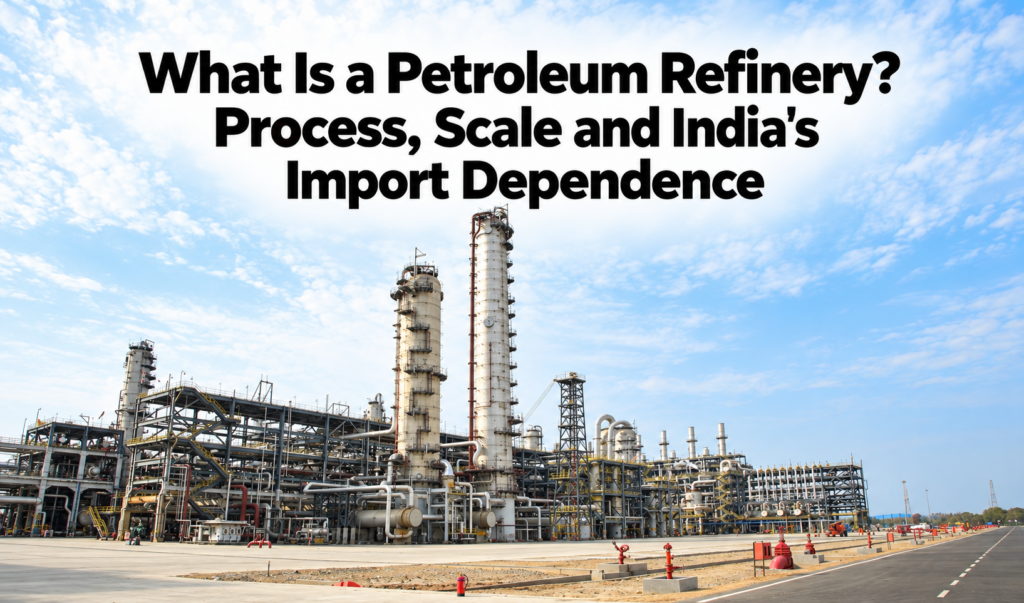
Ever wondered what actually happens between crude oil being pumped out of the ground and petrol going into your car’s tank? The answer sits in one place: the petroleum refinery. It’s an industry that quietly runs in the background of daily life, and the numbers behind it are larger and more dependent on imports than most people assume, even in a country that keeps adding refining capacity.
What Is a Petroleum Refinery?
In one sentence: a refinery is a large industrial facility that turns crude oil into things people can actually use: petrol, diesel, LPG, kerosene, jet fuel, and the feedstocks that eventually become plastics and chemicals.
Crude on its own is useless. It’s a mixture of hundreds of different hydrocarbons tangled together, and a refinery’s entire purpose is to separate that mixture, break down the parts nobody wants, and rebuild them into the parts everybody does. Picture one enormous, complicated ingredient that gets sorted, heated and portioned into dozens of different outputs; that’s roughly what happens inside an oil and gas refinery, at an industrial scale involving miles of piping, tall distillation columns, and round-the-clock operations.
Why Refining Crude Oil Matters — And Why the Numbers Are Getting Bigger
The U.S. Energy Information Administration expects global liquid fuels consumption to average a record 104.4 million barrels per day in 2025, with most of the growth concentrated in Asia; India alone is projected to add roughly 300,000 barrels per day of consumption in both 2024 and 2025, driven largely by transport demand.
On the supply side, refining throughput has also been climbing globally, even as capacity in some regions shrinks. U.S. refining capacity, for instance, fell to 19.117 million barrels per stream day as of January 2026 following the closure of two major refineries with no new capacity added to replace them.
India, by contrast, has been expanding. The Ministry of Petroleum and Natural Gas puts the country’s installed refining capacity at close to 249–258 MMTPA (million metric tonnes per annum) across 23 refineries (up sharply from 62 MMTPA in 1998), with government projections suggesting India will need around 439 MMTPA by 2030 to keep pace with rising domestic fuel demand.
The Part That Rarely Makes the Headline: Rising Import Dependence
Here’s the tension that capacity figures alone don’t capture. Even as India’s refining capacity grows, its dependence on imported crude oil has been rising, not falling. According to the Petroleum Planning and Analysis Cell (PPAC), India’s crude oil import dependency climbed from 85.5% in FY2023 to 87.8% in FY2024 and 88.2% in FY2025, and touched an all-time high of 90.6% in May 2025. Domestic crude production, meanwhile, has been on a broadly declining trend, down from 34.2 million tonnes in 2018 to lower levels in subsequent years, according to PRS Legislative Research analysis of PPAC data.
Put simply: India’s refineries are processing more crude than ever, but a growing share of that crude arrives by tanker rather than from Indian wells. Capacity to refine is not the same thing as energy self-sufficiency; the crude still has to come from somewhere, and increasingly, that somewhere is abroad.
How Does the Refining Process Work
The refining process typically unfolds across a series of connected stages:
- Crude oil receiving. Crude arrives by pipeline or tanker and is assessed for quality, density and sulphur content before processing begins. In India, inland refineries often depend on long pipeline networks running from coastal import terminals, since so much of the feedstock is seaborne.
- Distillation. Crude is heated until it vaporises, then fed into a distillation column where lighter fractions (LPG, naphtha) separate near the top, and heavier ones (diesel, fuel oil) lower down. It remains the most fundamental step in the plant.
- Conversion, or cracking. Heavy fractions left over from distillation are broken down into lighter, more valuable products using heat, catalysts, or both an energy-intensive step that lets refiners extract more high-demand fuel from each barrel. Fluid Catalytic Cracking and Delayed Coker units are common configurations for this at Indian refineries.
- Treatment and desulphurisation. Sulphur and other impurities are stripped out to meet environmental and quality standards, such as India’s Euro-VI norms, which cap sulphur content in fuel at 10 parts per million.
- Blending. Treated components are blended with additives to hit exact market specifications before storage and dispatch.
What Does a Refinery Actually Produce?
More than fuel, which tends to surprise people:
- Transport fuels: petrol, diesel, aviation turbine fuel
- Cooking and heating fuels: LPG, kerosene
- Petrochemical feedstocks: naphtha, propylene, ethylene, the starting points for plastics, synthetic fibres and rubber
- Industrial by-products: bitumen, lubricants, pet coke
This is why the refining industry sits across two categories at once: part energy sector, part manufacturing feedstock supplier.
HMEL’s Bathinda Refinery (Working Example)
HMEL (HPCL-Mittal Energy Limited), a joint venture between Hindustan Petroleum Corporation Limited and Mittal Energy Investments, operates the Guru Gobind Singh Refinery (GGSR) at Bathinda, Punjab. Commissioned in 2011–2012 with an initial capacity of 9 MMTPA, it has since been expanded to 11.3MMTPA. Crude arrives via a Single Point Mooring buoy off Mundra, Gujarat, and travels over 1,000 kilometres by pipeline to Bathinda, a routing that illustrates, at facility level, the same import-dependent supply chain reflected in the national data above.
Beyond fuels, the refinery complex also houses a dual-feed cracker producing polymers polypropylene and polyethelen, alongside the standard slate of motor spirit, diesel, ATF, LPG, naphtha, pet coke and sulphur.
Refining and the Environment
Refining is an energy-intensive industry, making responsible management of emissions, effluents and waste an important part of sustainable operations. Across India, refiners have been strengthening their environmental practices through improved technologies, tighter monitoring and investments in cleaner processes. Measures such as sulphur recovery units and compliance with stringent fuel-quality standards such as Euro-VI, which limits sulphur content to 10 ppm, have helped raise the environmental performance standards of the sector.
For refiners like HMEL, these evolving standards also present an opportunity to combine operational efficiency with responsible resource and environmental management. By adopting cleaner technologies, improving process efficiency and continuously strengthening environmental controls, the refining sector can support growing energy needs while working towards a more sustainable future.
In conclusion, a petroleum refinery is the link connecting crude oil to nearly every fuel and material product used daily. But the Indian refining story isn’t simply one of expanding capacity; it’s one where capacity and import dependence have grown side by side, with domestic crude production unable to keep pace with rising consumption. Facilities such as HMEL’s Bathinda refinery and the more than 1,000-kilometre pipeline that feeds it from an import terminal on the coast are a reasonably literal illustration of that dependency in action.




 no updates