

Ask five people what green energy is, and you’ll probably get five different answers. One will say solar panels. Another will say anything that isn’t coal. The phrase turns up in headlines, annual reports and product labels, so it helps to settle what is green energy before getting into examples.
Green Energy Meaning and Definition
The usual definition of green energy is power from sources with a low environmental impact across their whole life, from building the equipment to running it and eventually retiring it. Most green energy is also renewable. The United Nations describes renewable energy as coming from natural sources that replenish themselves faster than we use them, with sunlight and wind as the obvious examples.
“Green” is the looser word, though. No single regulator decides what qualifies, except in specific cases like green hydrogen, where the label depends on how the hydrogen is made. So the green energy meaning in one report may not match the one in the next.
Green Energy vs Renewable Energy
The two overlap heavily, but they aren’t the same thing. A large reservoir hydropower project is renewable, yet it can flood land and change how a river flows. Bioenergy is renewable too, but crops grown for fuel need land and water, and India’s ethanol programme shows how quickly that trade-off turns into a debate. A source counts as green when its costs to the environment are low, not just because it replenishes.
India’s numbers give some context. Installed renewable capacity reached roughly 254 GW by December 2025, and the government’s target is 500 GW of non-fossil capacity by 2030. We go through those figures in more detail in our piece on renewable energy in India.
Types of Green Energy
The main types of green energy are:
- Solar, from photovoltaic panels or mirrors that concentrate heat
- Wind, from onshore and offshore turbines
- Hydropower, from water moving downhill
- Geothermal, from heat stored in the Earth’s crust
- Bioenergy, from wood, crop residue and other organic material
- Green hydrogen, made by splitting water with renewable electricity
Each has limits. Solar and wind depend on weather, hydropower depends on rivers and geography, and geothermal only works where the right rock and heat exist.
How Is Green Energy Produced?
How does green energy work in practice? Solar panels use the photovoltaic effect: sunlight knocks electrons loose in a semiconductor and creates a current. Wind turbines turn moving air into spinning blades attached to a generator. Hydropower does the same job with falling water, and geothermal plants bring up hot water or steam and run it through turbines.
Green hydrogen is the odd one out. Here, how is green energy produced is a question of electrolysis, which uses electricity to split water into hydrogen and oxygen. If that electricity comes from solar or wind, the hydrogen earns the green label.
Everyday Examples
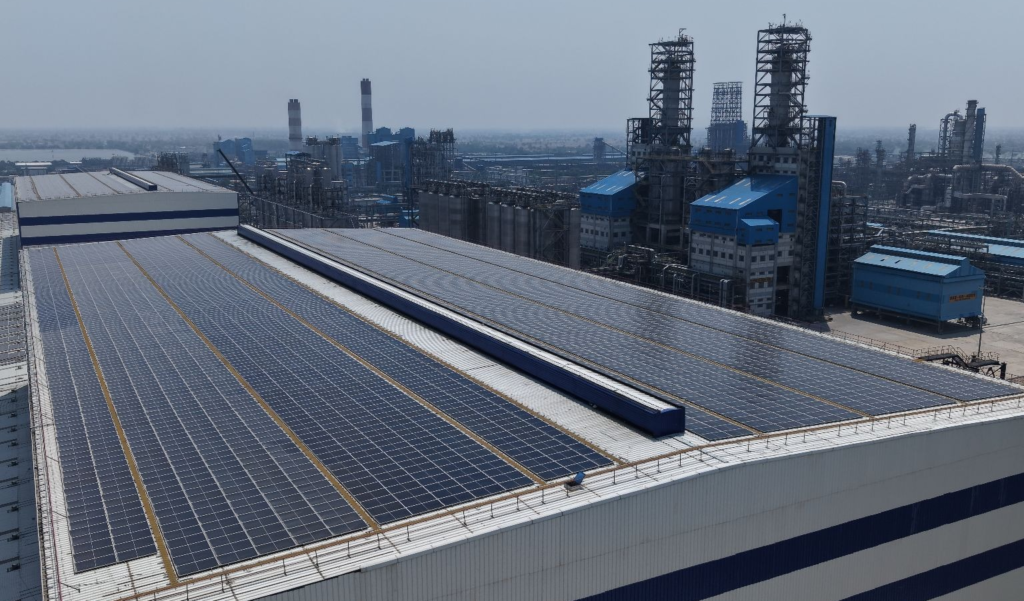
You’ve probably seen green energy without thinking about it. Rooftop solar panels on apartment blocks, solar pumps on farms, and wind turbines along the coast in Tamil Nadu and Gujarat are all common sights. Rajasthan and Gujarat have built some of the country’s biggest solar parks. The technology is no longer exotic. What’s changing is the scale.
Uses and Benefits of Green Energy
The uses of green energy start with electricity for homes and factories, but they stretch further. Industry uses it for processing heat, electric vehicles rely on it for charging, and green hydrogen could replace the fossil-based hydrogen used to make fertilizer and refine fuel. India already uses about 6 million tonnes of hydrogen a year, nearly all of it for those two jobs and mostly made from fossil fuels.
The benefits of green energy are fairly concrete. Once a solar or wind plant is built, there’s no fuel to buy. Running it produces far less carbon dioxide than burning coal or gas. And a country that generates more of its own power depends less on imported fuel. None of this makes the transition easy, but the gains are real.
Where India’s Green Hydrogen Plans Stand
The National Green Hydrogen Mission targets 5 million tonnes a year by 2030. Recent reporting shows a gap between what’s been awarded and what’s been built. About 862,000 tonnes a year of capacity has been awarded, roughly 17% of the target, while only around 0.16% has been commissioned, according to Business Today. Right now, the plans are bigger than the plants.
The Supply Chain Behind the Numbers
Generating green power and making the equipment for it are two different jobs. China still supplies roughly 56 to 59% of India’s solar cell and module imports. That’s down from over 90% a few years earlier, but it’s still the largest share. Electrolysers, the machines that make green hydrogen, are also largely imported, which pushes up project costs. So a new gigawatt of solar in India is often a mix of local assembly and imported parts.
That’s the quiet caveat in the green energy story. Capacity can grow quickly. Domestic manufacturing takes longer, and it will decide how much of the transition India really controls.
 no updates