

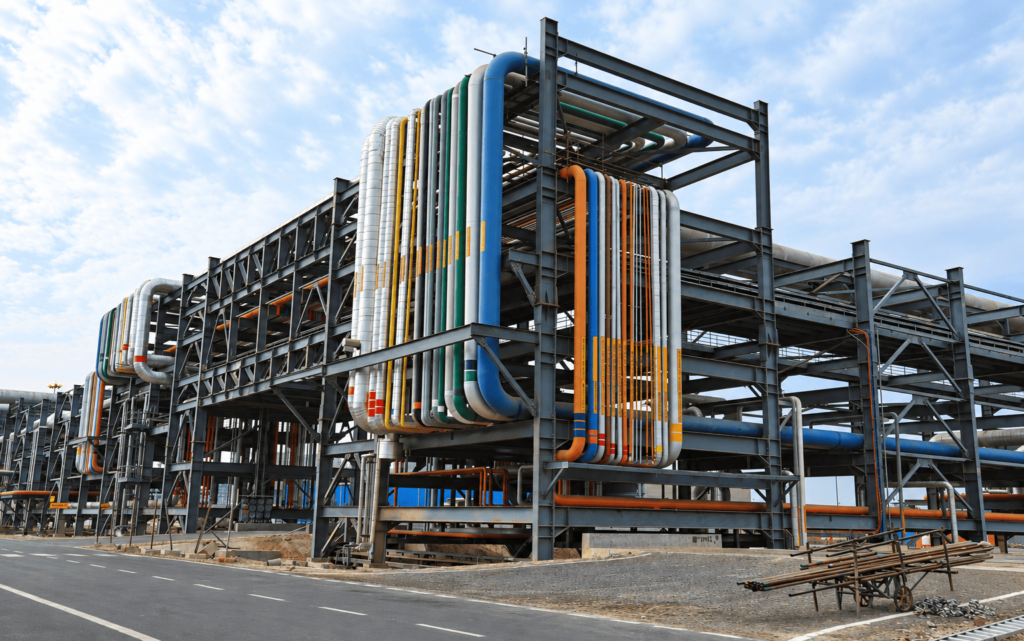
For most Indian households, LPG is simply the cylinder in the kitchen. Behind that familiarity sits a fuel that’s chemically straightforward but logistically complicated, one where India’s growing household access hasn’t yet translated into the energy independence the scale of the rollout might suggest.
What LPG Actually Is
LPG stands for liquefied petroleum gas, and it’s primarily a mixture of propane and butane, both naturally odourless gases. In India, as in most markets outside a handful of countries that use pure propane, LPG sold to households and industry is a propane-butane blend. Because an odourless, invisible gas leak would otherwise go undetected, an odorant is deliberately added during processing so that any leak has a distinct, noticeable smell.
LPG is produced two ways: as a byproduct of petroleum refining, where it’s separated out during crude oil distillation, or extracted during natural gas processing, where it’s recovered alongside methane before the gas is piped onward. Most supply in India comes from a mix of both sources rather than exclusively one.
Properties
LPG has a high calorific value, meaning it releases a large amount of heat for a given volume, which is part of why it’s an efficient cooking fuel. At normal atmospheric pressure, LPG exists as a gas, but it liquefies under modest pressure, which is what allows it to be compressed into a liquid for storage and transport in cylinders and then released as a gas when the valve is opened. It also burns with very low sulphur content compared to many other fuels, which keeps combustion relatively efficient at the point of use.
How It’s Produced
As noted above, LPG comes from two distinct processes. Refinery-sourced LPG is separated out during the same fractional distillation process that produces petrol, diesel and other fuels, condensing near the top of the distillation column alongside naphtha since it’s among the lightest hydrocarbon fractions in crude. Gas-processing LPG is extracted from raw natural gas before it’s sent into pipelines, since raw natural gas often contains propane and butane alongside methane. India’s overall supply draws on both routes, through its refineries and through gas processing facilities, with the balance between the two varying by region and by the specific fields and refineries involved.
Where It’s Used
Domestic cooking is by far the dominant use case in India, scaled up considerably through the Pradhan Mantri Ujjwala Yojana (PMUY), which has extended LPG connections to tens of millions of previously unconnected rural and low-income households since its 2016 launch. Beyond the kitchen, LPG serves industrial and commercial applications including metalworking and food processing, auto LPG as a vehicle fuel alternative, and as a propellant in aerosol products.
India’s LPG Story
This is where LPG’s household familiarity runs into a less comfortable supply chain reality. India is the world’s second-largest LPG importer, behind only China, with domestic production meeting only around 40% of national demand. The remaining 60%-plus is imported, and the Middle East supplies the overwhelming majority of that, commonly cited at over 90% of import volumes, which concentrates India’s cooking gas security around a single geopolitical region. Supply disruptions originating there, as seen during recent West Asia conflicts, have directly pushed up domestic LPG prices and tightened availability with little warning.
PMUY’s expansion tells a similarly two-sided story. The scheme has extended LPG connections to over 95 million households, a genuinely large increase in access. But a connection isn’t the same as sustained use. Government data from FY23 showed the average PMUY beneficiary refilled their cylinder roughly 3.7 to 4.5 times a year, compared to around 6.65 times for non-Ujjwala consumers, and approximately 12% of PMUY beneficiaries didn’t take a single refill that entire year. The gap largely comes down to affordability: when LPG prices rise, even households with a free connection and a free first cylinder can find themselves unable to keep refilling, and some fall back on traditional solid cooking fuels instead. Connection numbers alone don’t capture whether a household is actually using LPG as its primary cooking fuel day to day, and that distinction matters more as import-driven price volatility continues to shape what households can afford to keep buying.
Safety
LPG’s biggest practical hazard is undetected leaks, which is why the odorant added during processing is such a critical safety feature rather than a minor additive. Cylinders should be stored upright, away from direct heat sources and open flames, and in a ventilated area, since LPG is heavier than air and can pool near the ground if it leaks, increasing fire risk in enclosed spaces. Regular checks on cylinder valves, regulators and connecting tubes, along with using only BIS-certified equipment, form the baseline safety practice recommended for household use.
Who Produces It
LPG in India is supplied by the country’s major refiners and gas processors, including Indian Oil Corporation, Bharat Petroleum, Hindustan Petroleum and HPCL-Mittal Energy (HMEL), alongside a substantial and growing volume of imports that fill the gap domestic refining alone cannot meet. The balance between domestic LPG producers in India and imported supply is likely to remain import-heavy for the foreseeable future, given how far domestic production trails total demand.
Where This Leaves LPG
LPG’s basic chemistry and household role are simple enough. What’s less simple is the supply chain underneath it: a fuel that now reaches over 300 million household connections in India, resting on an import dependence of 60% or more, concentrated in a single, periodically volatile supplier region, with real gaps between who has a connection and who can consistently afford to use it. Household energy access and household energy security turn out to be two different achievements, and India’s LPG story has made far more progress on the first than the second.


 no updates