

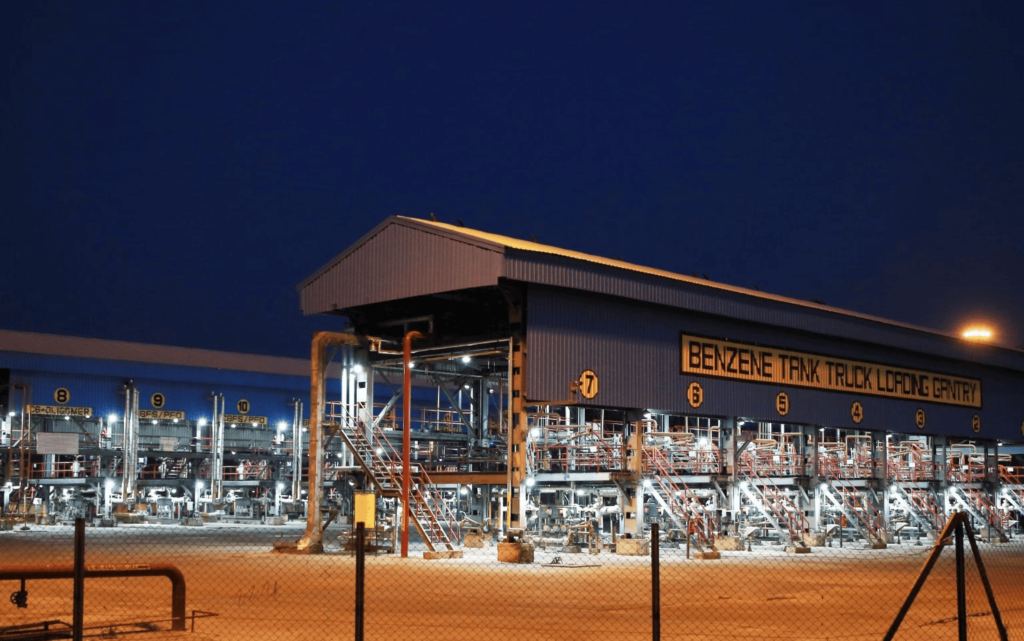
Most people fill a tank without thinking about what happened before the fuel reached the pump. The honest answer is a surprisingly long sequence of heating, separating, chemically rearranging and blending, all of it happening inside a petroleum refinery long before the petrol ever reaches a forecourt.
Where Petrol Starts
Crude oil is a mixture of hundreds of different hydrocarbons, from very light gases to thick, heavy residues, all tangled together in roughly the same liquid. It forms over millions of years, as the remains of ancient marine organisms get buried under layers of sediment, cut off from oxygen, and slowly transformed by heat and pressure into the mixture refineries process today.
None of that raw mixture can go straight into an engine. Petrol specifically corresponds to a narrow band of lighter hydrocarbons within crude, roughly in the four to twelve carbon atom range, and a refinery’s first job is to pull that band out from everything else.
Distillation: Separating the Mixture
Crude oil is heated in a furnace until it vaporises and fed into a tall distillation column. As the vapour rises, it cools, and different hydrocarbons condense out at different heights depending on their boiling point. The lightest fractions, LPG and naphtha, separate out near the top.
Heavier fractions like diesel and fuel oil settle lower down, and the heaviest residues, including bitumen, come off at the bottom. The petrol fraction condenses somewhere in the middle, but what comes off the column at this stage still isn’t road-ready fuel.
Why Distillation Alone Isn’t Enough
Straight-run naphtha, the petrol-range fraction fresh out of distillation, has too low an octane rating for a modern engine to run on efficiently. Octane rating measures a fuel’s resistance to knocking, the uncontrolled early ignition that damages engines and wastes energy, and distillation alone doesn’t produce a high enough rating.
This is where catalytic reforming and isomerisation come in. Catalytic reforming rearranges the molecular structure of naphtha using heat and a catalyst, typically platinum-based, converting straight-chain hydrocarbons into branched and ring-shaped ones that burn more efficiently and resist knocking better. Isomerisation does something similar on a smaller scale, converting straight-chain molecules into higher-octane branched versions.
Separately, catalytic cracking breaks down heavier molecules left over from distillation into lighter, petrol-range ones, which is as much about yield as it is about octane: it lets a refinery extract more usable fuel from each barrel rather than being stuck with whatever ratio distillation alone would produce.
Treatment and Additives
Once the right hydrocarbon blend is assembled, it still needs treatment. Sulphur compounds are removed to meet environmental standards, since sulphur in fuel converts to sulphur oxides during combustion, contributing to air pollution and engine corrosion. Additives are then blended in: octane boosters to fine-tune the final rating, detergents to keep fuel injectors and intake valves clean, and corrosion inhibitors to protect the fuel system. Pump petrol is, in that sense, a formulated product rather than a raw extract.
Blending to Spec
The final blend has to hit a specific Research Octane Number, commonly 91 or 95 depending on the market and grade, along with other regulatory specifications covering volatility, sulphur content and more. In India, petrol sold at the pump is also blended with ethanol as part of the national ethanol blending mandate, currently set at a 20% ratio (E20). That blending happens at this stage, alongside the octane and additive adjustments, rather than as a separate process. The water, land use and feedstock trade-offs behind that ethanol component are worth a closer look on their own, and are covered separately rather than here.
What a Barrel Actually Yields
A refinery doesn’t produce petrol in isolation. A single barrel of crude yields a spread of products at once, petrol, diesel, jet fuel, LPG, residues and more, and refiners actively manage that mix rather than letting it fall out passively from the crude’s natural composition. The ratio they aim for shifts with seasonal demand and government fuel mandates: refiners typically dial up diesel output during peak agricultural and freight seasons and adjust petrol and bitumen yields around that.
India’s refining sector has historically skewed toward diesel given the country’s heavy transport and agricultural fuel demand relative to private passenger petrol use, which is part of why petrol and diesel pricing, taxation and supply patterns in India don’t always move in lockstep even though both come from the same barrel at the same refinery.
Where the Crude Itself Comes From
All of the above assumes crude oil is sitting at the refinery gate ready to be processed, but it’s worth being clear about where that crude actually comes from. India’s refining capacity has grown steadily, yet its dependence on imported crude has been rising alongside it rather than shrinking. According to the Petroleum Planning and Analysis Cell, India’s crude oil import dependency climbed from 85.5% in FY2023 to 88.2% in FY2025, touching an all time high of 90.6% in May 2025, while domestic crude production has been on a broadly declining trend over the same period.
A refinery can only turn crude into petrol that it actually has on hand, and increasingly, that crude arrives by tanker from abroad rather than from a well inside the country. The process described above works the same way regardless of where the crude originated, but the sourcing side of it is far less self-sufficient than the sophistication of the refining process might suggest.
From Refinery to Pump
Once blended, petrol is stored and dispatched to distribution terminals, then trucked to individual fuel stations. The price at the pump bundles several components together: the base refinery price, excise duty, state-level VAT, dealer commission and transportation cost, and in India, taxation typically accounts for a substantial share of the final retail price, often closer to half, which is part of why petrol prices can vary noticeably between neighbouring states even when the underlying fuel comes from the same source.
Where This Leaves the Process
Petrol looks simple at the pump: one grade, one price, one nozzle. Getting there involves separating a barrel of crude into its components, chemically rebuilding part of that mixture to raise its octane rating, treating it to meet emissions standards, blending in ethanol and additives, and finally taxing and distributing it through a supply chain that spans the length of the country. It’s less a single product than the end point of a long sequence of engineering and policy decisions stacked on top of each other.



 no updates